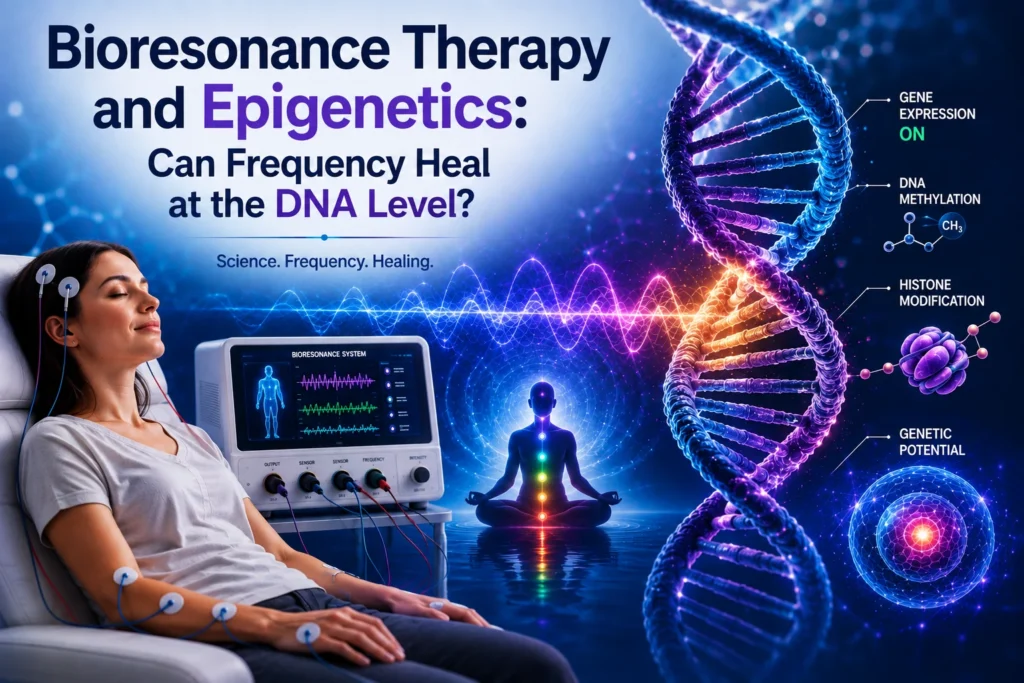
Can bioresonance therapy affect DNA or epigenetics? Current research does not prove that bioresonance therapy can directly repair or rewrite DNA. However, research into epigenetics and integrative medicine suggests that some health and environmental factors may influence gene expression without changing the DNA sequence itself.
This distinction is important when exploring the possible connection between bioresonance therapy, frequency-based approaches, and holistic wellness.
What Is Epigenetics?
Epigenetics refers to changes in how genes are switched on or off without changing the underlying DNA sequence.
Think of DNA as an instruction manual for the body. Epigenetic processes can influence which instructions are used more actively at different times.
Some important epigenetic mechanisms include:
- DNA methylation
- Histone modification
- Non-coding RNA regulation
- Changes in gene expression
These processes can respond to factors such as nutrition, stress, lifestyle, inflammation, and environmental influences.
Can Bioresonance Therapy Affect Epigenetics?
There is currently not enough scientific evidence to confirm that bioresonance therapy directly changes epigenetic markers in humans.
The possible connection is an area of interest because researchers are studying how different complementary and integrative approaches may interact with biological processes involved in gene regulation.
A review published in Evidence-Based Complementary and Alternative Medicine explored possible epigenetic mechanisms associated with integrative medicine. The researchers discussed how mind-body and complementary approaches could potentially influence biological pathways connected with gene expression.
However, this research does not establish that bioresonance therapy directly modifies DNA or produces specific epigenetic changes.
What Does Research Say About Frequency and Gene Expression?
Frequency-based approaches are sometimes discussed in relation to the body’s biological signaling systems. The theory behind bioresonance therapy suggests that specific frequencies may interact with the body’s natural energetic or electromagnetic processes.
From an advanced holistic wellness perspective, this idea is often considered as part of a broader view of the body and its interconnected systems.
But there is an important scientific limitation: a proposed mechanism is not the same as clinical proof.
The current research does not provide enough evidence to state that bioresonance frequencies can reliably change gene expression or repair DNA in people.
Does Bioresonance Therapy Repair DNA?
No, there is currently no strong clinical evidence showing that bioresonance therapy repairs damaged DNA.
DNA repair is a complex biological process carried out by specialized cellular mechanisms. Epigenetic regulation is different because it generally affects gene activity without changing the DNA sequence.
Therefore, saying that a therapy “heals DNA” can be misleading.
If research eventually demonstrates that a particular frequency-based intervention influences epigenetic markers, that would still not necessarily mean that it repairs or rewrites the DNA sequence.
Why Is the Bioresonance and Epigenetics Connection Interesting?
The connection is interesting because modern biology increasingly recognizes that gene activity is influenced by the body’s internal and external environment.
Researchers are investigating how factors such as:
- Stress and emotional experiences
- Nutrition and metabolic health
- Sleep and lifestyle
- Environmental exposures
- Cellular signaling
may interact with pathways involved in gene regulation.
This broader understanding has created interest in complementary approaches and their possible biological effects.
For natural healing therapy, however, it is important to distinguish between an emerging scientific idea and a treatment that has been clinically proven.
What Can a Bioresonance Therapist Do?
A bioresonance therapist may use frequency-based techniques as part of a complementary wellness approach. The exact methods can vary depending on the practitioner and system being used.
A responsible practitioner should explain what the therapy is intended to support and avoid making unsupported promises about curing diseases or repairing DNA.
Bioresonance should also not be presented as a replacement for medical diagnosis, prescribed medication, or evidence-based treatment.
Instead, people may choose to explore complementary wellness approaches alongside healthy lifestyle habits and appropriate healthcare.
Is Bioresonance Therapy Scientifically Proven?
Bioresonance therapy has not been scientifically established as a method for repairing DNA or controlling epigenetic changes.
Research into frequency-based therapies and biological signaling continues, but evidence can vary depending on the specific application.
This means consumers should be cautious about claims that promise guaranteed genetic, cellular, or disease-related results.
The most reliable approach is to look for well-designed human studies rather than relying only on theoretical explanations or testimonials.
Bioresonance Therapy and Epigenetics: What We Know
Here is the simple takeaway:
- Epigenetics affects how genes are expressed without changing the DNA sequence.
- Lifestyle and environmental factors can influence biological processes involved in gene regulation.
- Research has explored possible links between integrative medicine and epigenetic mechanisms.
- Bioresonance therapy has not been proven to repair or rewrite DNA.
- More high-quality research is needed to determine whether specific frequency-based approaches can produce measurable biological or epigenetic effects.
- Bioresonance is best considered a complementary wellness approach rather than a replacement for medical treatment.
Frequently Asked Questions
Can frequency therapy change DNA?
There is currently insufficient evidence to show that frequency therapy can directly change or repair human DNA.
What is the difference between DNA and epigenetics?
DNA contains genetic information, while epigenetics refers to processes that regulate how genes are expressed without changing the underlying DNA sequence.
Can bioresonance therapy influence gene expression?
There is not enough high-quality human evidence to confirm that bioresonance therapy reliably changes gene expression.
Is bioresonance therapy a natural healing therapy?
Bioresonance may be used as a complementary wellness approach, but claims about specific healing effects should be evaluated based on scientific evidence.
Should bioresonance replace medical treatment?
No. Bioresonance should not replace medical diagnosis or prescribed treatment. Anyone with a health condition should consult an appropriately qualified healthcare professional.
Final Thoughts
The connection between bioresonance therapy and epigenetics is an interesting area for continued research. Epigenetics has shown that gene activity can respond to many biological and environmental influences, but that does not mean every complementary therapy has been proven to affect DNA or gene expression.
At DNA Resonance Care, the conversation around advanced holistic wellness can remain both open-minded and evidence-aware. Bioresonance may be explored as a complementary wellness approach, while claims about DNA healing should be approached carefully until stronger scientific evidence becomes available.