
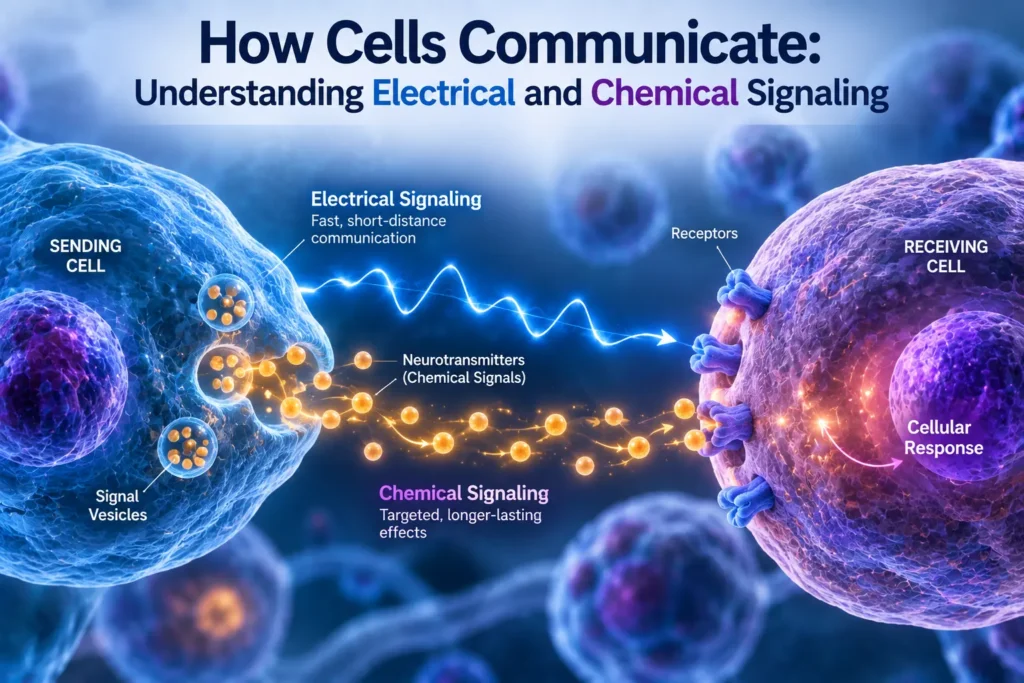
Cells communicate by sending and receiving signals that help them coordinate important functions. The two major forms of cell signaling are electrical signaling, which uses changes in electrical charge, and chemical signaling, which uses molecules such as hormones and neurotransmitters.
Key Takeaways
- Cells constantly communicate to maintain normal body functions.
- Electrical signals are especially important in nerve and muscle cells.
- Chemical signals can act locally or travel throughout the body.
- Many cellular processes depend on both electrical and chemical signaling.
- Cell communication helps regulate movement, growth, metabolism, and responses to changes.
What Is Cell Communication?
Cell communication is the process through which cells send, receive, and respond to information. This communication allows cells to work together instead of functioning independently.
Signals can tell a cell to change its activity, release a substance, move, grow, divide, or respond to something happening around it. Specialized proteins called receptors help cells detect specific signals.
Two important ways cells communicate are electrical and chemical signaling.
How Does Electrical Signaling Work?
Electrical signaling occurs when there is a change in the electrical charge across a cell membrane. This is particularly important in neurons and muscle cells.
Cells maintain different concentrations of charged particles, or ions, inside and outside their membranes. When ion channels open, ions such as sodium, potassium, calcium, or chloride can move across the membrane. This changes the cell’s electrical state.
In nerve cells, a rapid electrical signal called an action potential can travel along the cell. This allows information to move quickly from one part of the nervous system to another.
Electrical signaling is also essential for muscle contraction. Signals from nerve cells can trigger changes in muscle cells, helping them contract and produce movement.
What Is Chemical Signaling?
Chemical signaling occurs when cells use chemical molecules to communicate. These molecules can attach to receptors on the surface of a cell or inside it.
Neurotransmitters are one example. When a nerve signal reaches the end of a neuron, it can cause neurotransmitters to be released. These chemicals cross a tiny gap between cells and bind to receptors on another cell.
Hormones are another type of chemical signal. They are released by specialized cells or glands and can travel through the bloodstream to reach target cells in different parts of the body.
Other chemical signals work over shorter distances, allowing nearby cells to coordinate their activities.
Electrical vs Chemical Signaling
| Feature | Electrical Signaling | Chemical Signaling |
| Main mechanism | Changes in electrical charge | Release and detection of chemical molecules |
| Speed | Usually very fast | Can range from fast to relatively slow |
| Common examples | Nerve impulses, muscle activity | Hormones, neurotransmitters |
| Communication range | Often along a cell | Local or throughout the body |
| Main role | Rapid information transfer | Regulation and coordination |
These systems are not completely separate. In many situations, electrical signals trigger chemical signals, which then produce another response in a nearby cell.
How Do Cells Know Which Signals to Receive?
Cells do not respond to every signal around them. A cell usually responds only when it has the appropriate receptor.
Think of a receptor like a lock and a signaling molecule like a key. When the correct molecule binds to its receptor, it can start a series of changes inside the cell.
This process is known as signal transduction. The original signal is converted into cellular instructions that can influence processes such as enzyme activity, gene expression, metabolism, or movement.
Why Is Cell Communication Important?
Cell communication is essential for maintaining coordination within living organisms. It helps regulate processes such as:
- Nervous system activity
- Muscle contraction
- Heart function
- Hormone responses
- Immune system activity
- Cell growth and division
- Metabolism
- Responses to changes in the environment
Without effective communication, cells would struggle to coordinate their activities and maintain normal biological functions.
How Electrical and Chemical Signals Work Together
A useful example is communication between nerve and muscle cells. An electrical signal travels along a neuron and reaches its end. This triggers the release of chemical neurotransmitters. The neurotransmitters then bind to receptors on the muscle cell and can produce an electrical change that contributes to muscle contraction.
This shows why electrical and chemical signaling are best understood as connected systems rather than completely separate processes.
Understanding Cell Signaling With DNA Resonance Care
Cell communication is a complex biological process involving electrical activity, chemical messengers, receptors, and cellular responses. Understanding these basic mechanisms can make it easier to appreciate how different systems in the body coordinate their activities.
DNA Resonance Care focuses on approaches related to understanding the body’s biological processes. When exploring any health-related concern, it is important to use information from qualified healthcare professionals alongside general educational resources.
FAQs
What are the two main types of cell signaling?
Two major forms are electrical signaling and chemical signaling. Electrical signaling involves changes in membrane voltage, while chemical signaling uses molecules that interact with receptors.
Why do cells need to communicate?
Cells communicate to coordinate functions such as growth, movement, metabolism, immune responses, and nervous system activity.
Which cells commonly use electrical signaling?
Neurons and muscle cells commonly rely on electrical signaling because they need to transmit information or respond rapidly.
What are examples of chemical signals?
Examples include neurotransmitters, hormones, and other signaling molecules that allow cells to communicate with nearby or distant target cells.
Can electrical and chemical signaling work together?
Yes. Many biological communication pathways use both. For example, an electrical signal in a neuron can trigger the release of chemical neurotransmitters.