
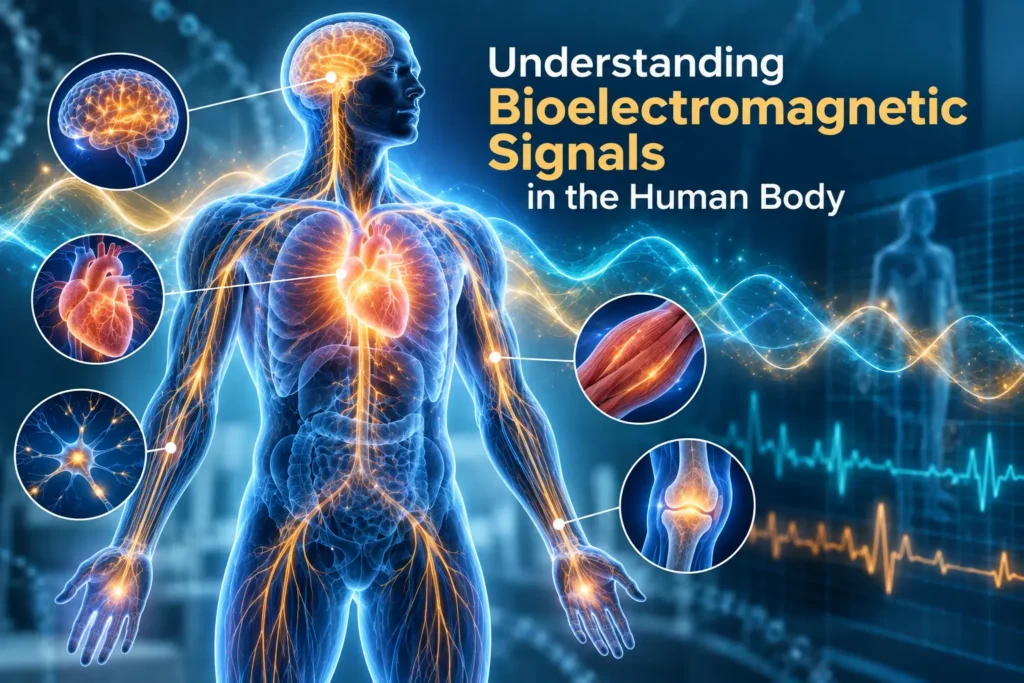
Bioelectromagnetic signals are electrical and magnetic activities naturally produced by the human body. They are linked to processes such as nerve communication, muscle activity, heart function, and brain activity. Understanding these signals helps researchers study how different systems in the body communicate and function.
Key Takeaways
- The human body produces measurable electrical and magnetic signals.
- Nerves, muscles, the heart, and brain are major sources of bioelectromagnetic activity.
- These signals help coordinate important body functions.
- Medical technology can measure some bioelectromagnetic signals.
- Research into electromagnetic activity continues to explore how biological systems interact with their environment.
What Are Bioelectromagnetic Signals?
Bioelectromagnetic signals are electrical and magnetic phenomena generated by living tissues. They occur because cells, especially nerve and muscle cells, use electrical changes to communicate and perform their functions.
For example, when a nerve cell sends a signal, ions move across its cell membrane. This creates an electrical change that can travel along the nerve. Similar electrical activity occurs in the heart and muscles.
These signals are a normal part of human biology and can be measured using specialized equipment.
How Does the Human Body Produce These Signals?
Cells maintain differences in electrical charge across their membranes. This happens through the movement of charged particles, or ions, such as sodium, potassium, calcium, and chloride.
When cells become activated, ion movement changes their electrical state. Groups of active cells can create electrical currents and associated magnetic fields.
Some of the most important sources include:
Brain Activity
Neurons communicate through electrical signals. The combined activity of many neurons produces electrical patterns that can be measured with techniques such as electroencephalography (EEG).
Heart Activity
The heart’s electrical system controls the timing of heartbeats. This activity can be recorded using an electrocardiogram (ECG or EKG).
Muscle Activity
Muscle contraction depends on electrical signals that activate muscle fibers. Electromyography (EMG) can measure electrical activity associated with muscles.
Nerve Activity
Nerves use electrical impulses to transmit information throughout the body. These signals help control movement, sensation, and many automatic body functions.
Can Bioelectromagnetic Signals Be Measured?
Yes. Several established medical and scientific technologies measure bioelectromagnetic activity.
Common examples include:
- ECG: Records electrical activity of the heart.
- EEG: Measures electrical activity of the brain through electrodes placed on the scalp.
- EMG: Records electrical activity associated with muscles.
- Magnetoencephalography (MEG): Detects very weak magnetic fields produced by brain activity.
These technologies provide information about specific biological processes and are used in research and clinical settings.
Why Are Bioelectromagnetic Signals Important?
Bioelectromagnetic signals provide a way to observe how different tissues communicate and function. Because electrical activity is involved in the nervous, muscular, and cardiovascular systems, measuring these signals can provide useful biological information.
Researchers continue to investigate electrical and magnetic activity in living systems to better understand normal physiology and various health conditions.
It is important to distinguish established measurement techniques from claims that have not been supported by sufficient scientific evidence. Measuring a biological signal does not automatically show that changing that signal will treat a disease or improve health.
What Is the Role of Bioelectromagnetic Research?
Bioelectromagnetic research covers several areas, including how cells generate electrical activity, how tissues respond to electromagnetic fields, and how electromagnetic measurements can be used in medicine and neuroscience.
At DNA Resonance Care, interest in this area reflects the broader exploration of biological signals and their relationship to human physiology. However, any health-related application should be considered in the context of established scientific evidence and appropriate professional guidance.
Frequently Asked Questions
Are bioelectromagnetic signals natural?
Yes. Electrical activity and associated magnetic fields are natural consequences of processes occurring in living cells, particularly in the brain, heart, nerves, and muscles.
Can bioelectromagnetic signals be detected?
Yes. Instruments such as ECG, EEG, EMG, and MEG can detect or measure different forms of electrical or magnetic activity produced by the body.
Are bioelectromagnetic signals the same throughout the body?
No. Different tissues generate different patterns of electrical activity depending on their structure and function.
What is the connection between DNA and bioelectromagnetic signals?
DNA is a biological molecule with electrical properties, but claims about specific therapeutic effects of “DNA resonance” or similar approaches require careful evaluation against established scientific evidence.
Is bioelectromagnetic research still developing?
Yes. Scientists continue to study bioelectricity, biomagnetism, cellular signaling, and how biological tissues interact with electromagnetic fields.