
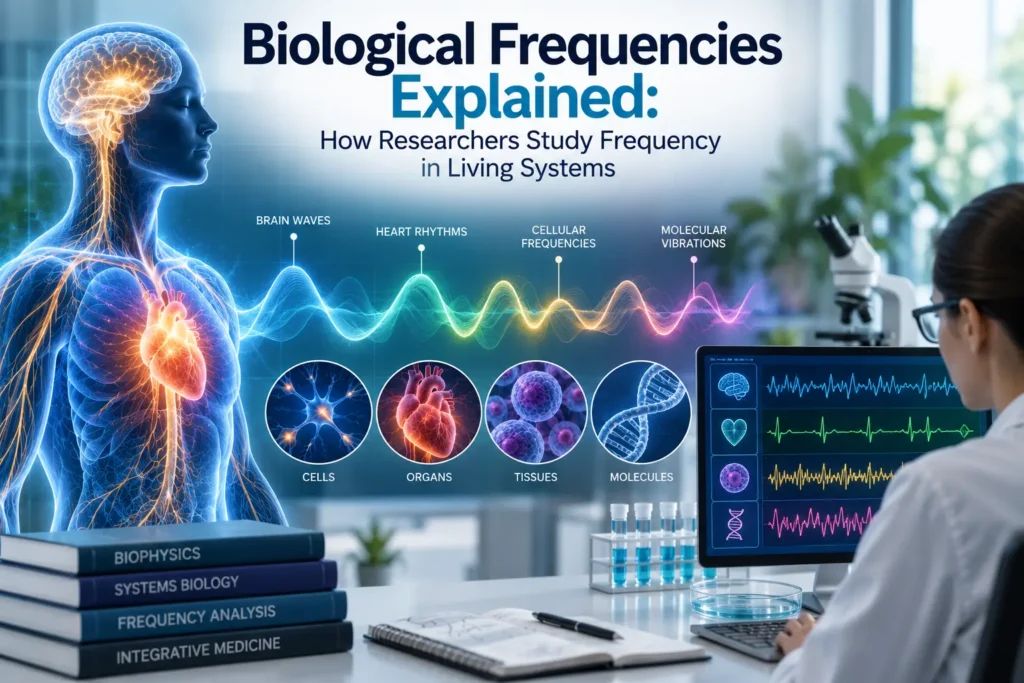
Biological frequencies are repeating patterns or rhythms observed in living systems. Researchers study them by measuring electrical, chemical, mechanical, and physiological signals over time. These measurements help scientists understand how cells, tissues, organs, and whole organisms function and respond to changes.
Key Takeaways
- Living systems produce many measurable rhythmic signals.
- Biological frequency can refer to electrical, mechanical, or physiological activity.
- Researchers use instruments and mathematical methods to identify frequency patterns.
- Frequency measurements are useful in physiology, neuroscience, cardiology, and other research fields.
- Frequency research does not automatically prove that a particular frequency can treat or cure a disease.
What Are Biological Frequencies?
Biological frequencies describe repeating patterns that occur in living organisms. Just as sound waves have frequencies, biological processes can also show measurable rhythms.
These rhythms may occur at different speeds. For example, the heartbeat produces a repeating electrical and mechanical pattern. Brain activity can also display different frequency ranges that researchers measure using instruments such as electroencephalography (EEG).
At the cellular level, researchers may study oscillations in calcium levels, membrane voltage, or other biological processes. The important point is that biological frequency is not one single frequency shared by the entire human body.
Why Do Researchers Study Frequency in Living Systems?
Frequency measurements can provide information about how biological systems behave over time.
Instead of looking at a biological signal only at one moment, researchers can examine how that signal changes and repeats. This can reveal patterns that may not be obvious from a simple measurement.
For example, researchers can study:
- Heart rhythm and electrical activity
- Brain-wave patterns
- Muscle activity
- Breathing rhythms
- Cellular oscillations
- Circadian and other biological rhythms
Studying these patterns can help researchers understand normal physiology and investigate how biological activity changes under different conditions.
How Are Biological Frequencies Measured?
Researchers use different technologies depending on the biological system being studied.
Electrical Measurements
Devices such as ECG and EEG record electrical activity associated with the heart and brain. Researchers can analyze these signals to identify repeating patterns and frequency components.
Mechanical Measurements
Some biological processes involve physical movement. Researchers can measure motion, vibration, pressure, or tissue activity using specialized sensors and imaging technologies.
Chemical and Cellular Measurements
At the cellular level, researchers may track changes in molecules, ions, or signaling pathways over time. These measurements can reveal oscillating or repeating biological processes.
How Does Frequency Analysis Work?
A biological signal can contain several patterns at the same time. Researchers often use mathematical techniques to separate these components.
One common method is Fourier analysis, which breaks a complex signal into different frequency components. Researchers can then examine which frequencies are stronger, weaker, or changing under specific conditions.
The frequency of a repeating event is commonly expressed in hertz (Hz). One hertz represents one cycle per second.
Researchers also consider factors such as signal strength, timing, variability, measurement conditions, and possible sources of noise.
Examples of Frequency Research
Frequency analysis is already used across several scientific fields.
In neuroscience, EEG recordings allow researchers to study rhythmic patterns in brain activity. In cardiology, ECG signals help researchers examine heart rate and rhythm. In sleep research, scientists analyze brain and physiological signals to understand different stages of sleep.
Researchers also investigate biological oscillations in cells and tissues. These studies can help explain how biological processes are coordinated and how they respond to internal or external changes.
Is Every Biological Frequency Clinically Important?
No. Finding a frequency pattern does not automatically mean that the frequency causes a biological effect or can be used as a treatment.
Researchers need controlled experiments to determine whether an observed relationship is meaningful. They also consider reproducibility, measurement accuracy, biological mechanisms, and clinical evidence.
This distinction is important when reading claims about frequency-based wellness or health technologies. A measurable biological signal is not, by itself, proof of a therapeutic benefit.
Biological Frequencies and DNA Resonance Care
DNA Resonance Care focuses on the broader interest in biological signals and frequency-based approaches. When exploring these concepts, it is useful to separate established scientific measurements from hypotheses, emerging research, and wellness claims.
A scientific approach asks clear questions: What was measured? How was it measured? Was the finding reproduced? What evidence supports the proposed biological effect?
Conclusion
Biological frequencies provide researchers with a useful way to study repeating patterns in living systems. By measuring electrical, mechanical, chemical, and physiological signals and analyzing their frequency components, scientists can better understand biological activity. As research continues, careful measurement and evidence-based interpretation remain essential when evaluating claims about frequency and health.
Frequently Asked Questions
What is a biological frequency?
A biological frequency is a measurable rate or rhythm associated with a biological process, such as electrical activity, heartbeat, brain activity, or cellular oscillation.
How are biological frequencies measured?
Researchers use tools such as ECG, EEG, sensors, imaging systems, and laboratory techniques to record biological signals. Mathematical analysis can then identify frequency patterns.
What is frequency measured in?
Frequency is commonly measured in hertz (Hz), which represents the number of cycles occurring per second.
Are biological frequencies the same in every person?
Not necessarily. Biological signals can vary between individuals and can also change with factors such as age, activity, sleep, environment, and health status.
Can frequency measurements diagnose disease?
Some frequency-related measurements are used as part of established medical tests, but a frequency pattern alone should not automatically be considered a diagnosis. Clinical interpretation depends on the specific test and medical context.