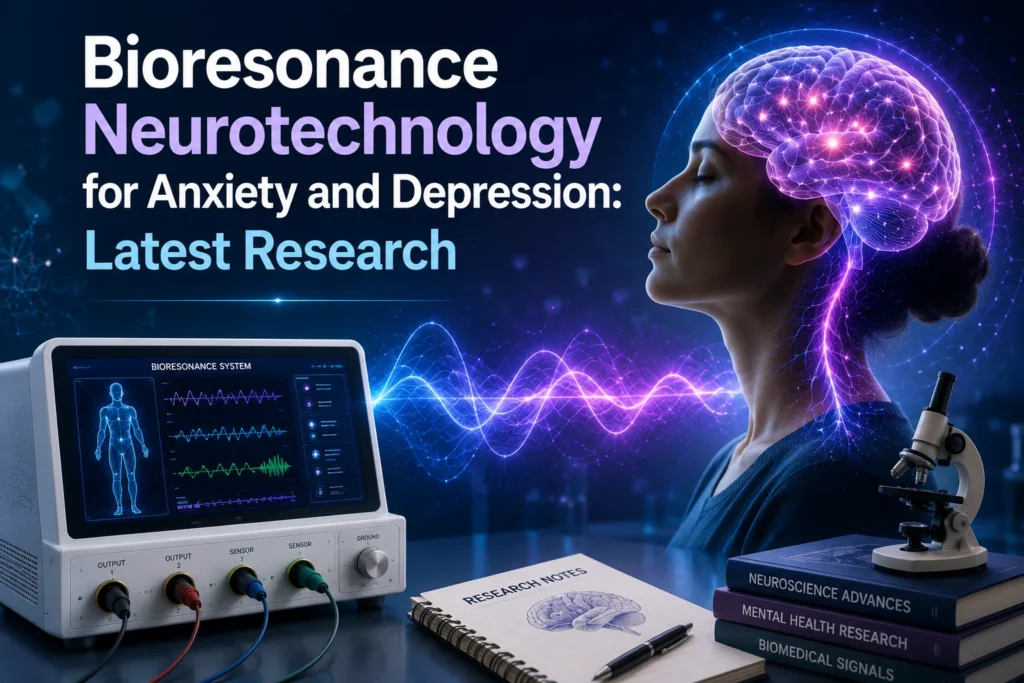
Anxiety and depression are among the most common mental health concerns, and many people are interested in approaches that may support emotional balance and overall well-being. One emerging area receiving research attention is bioresonance neurotechnology, particularly its potential use alongside non-invasive brain stimulation.
So, what does the latest research actually show? A recent pilot study investigated a combination of bioresonance neurotechnology (BRNT) and repetitive transcranial magnetic stimulation (rTMS) in people experiencing both major depressive disorder and generalized anxiety disorder. The results were encouraging, but the study was very small, meaning more research is needed before firm conclusions can be made.
What Is Bioresonance Neurotechnology?
Bioresonance neurotechnology is an emerging approach that combines different forms of stimulation designed to influence relaxation, nervous system activity, and brain states.
In the recent study, BRNT involved neuroacoustic brainwave entrainment, electromagnetic frequency bio-resonance, and light-blocking techniques. These methods were intended to encourage a more relaxed, parasympathetic-dominant state.
Importantly, this research looked at BRNT as part of a combined intervention with rTMS, rather than testing every type of bioresonance therapy available today.
What Does the Latest Research Show?
The recent pilot research explored whether combining BRNT with rTMS could help people with co-occurring anxiety and depression.
The study included three participants diagnosed with major depressive disorder (MDD) and generalized anxiety disorder (GAD). Researchers monitored changes using the PHQ-9, a commonly used depression questionnaire, and the GAD-7, which measures anxiety symptoms.
The researchers reported notable improvements in both measures following the intervention.
Key Research Findings
- Participants: 3 people with MDD and GAD
- Depression measurement: PHQ-9
- Anxiety measurement: GAD-7
- Average PHQ-9 difference: 20 points
- Average GAD-7 difference: 18.67 points
- Intervention: BRNT combined with rTMS
- Research stage: Preliminary pilot study
These findings suggest that the combined approach deserves further investigation. However, the very small sample means the results cannot be generalized to everyone experiencing anxiety or depression.
You can read the original research in this PubMed study on bio-resonance neurotechnology and rTMS.
How Could BRNT Support Emotional Wellness?
The idea behind BRNT is connected to nervous system regulation. Some approaches used within the technology are intended to encourage relaxation and support a shift toward parasympathetic activity.
The parasympathetic nervous system is often associated with the body’s “rest and digest” functions. Supporting relaxation may be relevant for people who frequently experience stress or heightened nervous system arousal.
However, it is important not to turn this concept into a medical promise. The available study does not establish that BRNT independently treats depression or anxiety. It examined a specific combination of BRNT and rTMS.
That distinction matters when discussing bioresonance therapy responsibly.
Can Bioresonance Therapy Help With Anxiety?
Early research suggests that certain bioresonance-based approaches may have potential when used as part of a broader intervention, but the evidence is still limited.
The recent pilot study reported improvements in GAD-7 scores after participants received the combined BRNT and rTMS intervention. However, because only three people participated, larger clinical studies are required to determine whether similar results occur consistently in a wider population.
Therefore, bioresonance therapy should currently be viewed as an emerging area of research rather than a proven standalone treatment for anxiety.
Can Bioresonance Neurotechnology Help With Depression?
The same study reported a substantial reduction in PHQ-9 scores among participants following the combined intervention.
This is an interesting finding because it suggests that approaches involving nervous system and brain stimulation may deserve additional research. At the same time, the study does not prove that BRNT alone caused the improvement.
Other factors, including the rTMS component and the combined treatment protocol, may have contributed to the observed changes.
Is Bioresonance Neurotechnology Scientifically Proven?
Not yet.
The research is promising but preliminary. A three-person pilot study is not enough to establish effectiveness, long-term outcomes, or how the approach compares with established treatments.
Future research should include larger participant groups, control or sham groups, blinded study designs, and longer follow-up periods. These steps can help researchers determine whether the observed improvements are reproducible.
This is particularly important when discussing therapies related to mental health.
What Does This Mean for Advanced Holistic Wellness?
The growing interest in nervous system regulation reflects a broader movement toward advanced holistic wellness, where physical, emotional, and lifestyle factors may be considered together.
For someone exploring complementary wellness options, bioresonance-based approaches may be an area worth learning about. However, a holistic approach should still be evidence-aware.
A responsible natural healing therapy should complement informed healthcare decisions rather than encourage people to stop prescribed treatment or avoid professional support.
How to Choose a Bioresonance Therapist
If you are considering working with a bioresonance therapist, look for a practitioner who communicates clearly about what the technology can and cannot do.
A responsible practitioner should:
- Explain the therapy before beginning a session.
- Avoid promising guaranteed cures or results.
- Discuss your individual wellness goals.
- Be transparent about the current level of scientific evidence.
- Encourage appropriate medical or mental health care when necessary.
- Treat bioresonance as a complementary wellness approach rather than a replacement for professional treatment.
This kind of transparent approach helps people make informed decisions about their well-being.
What the Research Does Not Prove
It is just as important to understand the study’s limitations as its positive findings.
The research does not prove that all forms of bioresonance therapy treat anxiety or depression. It also does not establish that BRNT alone was responsible for the reported improvements because the intervention included rTMS.
Most importantly, only three participants were included. Larger and more rigorous clinical research is needed before the findings can be considered conclusive.
Frequently Asked Questions
What is bioresonance neurotechnology?
Bioresonance neurotechnology is an emerging approach involving techniques such as neuroacoustic stimulation, electromagnetic frequency bio-resonance, and light-blocking methods. It is being researched for its potential role in the nervous system and emotional wellness.
Can bioresonance therapy help with depression?
Early research has reported improvements in depression scores following a combined BRNT and rTMS intervention. However, current evidence is too limited to say that bioresonance therapy independently treats depression.
Can BRNT help with anxiety?
A small pilot study reported reduced anxiety scores after a combined BRNT and rTMS intervention. More research is needed to confirm whether the approach is consistently effective.
Is bioresonance therapy a replacement for mental health treatment?
No. Current research does not support using bioresonance therapy as a replacement for established mental health care. Anyone experiencing persistent or severe symptoms should seek appropriate professional support.
Is more research needed?
Yes. Larger, controlled, and blinded clinical studies are needed to better understand the effectiveness, safety, and long-term outcomes of bioresonance neurotechnology.
Final Thoughts
The latest research on bioresonance neurotechnology for anxiety and depression is interesting, but it is still at an early stage. A small pilot study found improvements in anxiety and depression scores following a combined BRNT and rTMS intervention, offering a reason for further scientific investigation.
At DNA Resonance Care, exploring emerging wellness technologies should always go hand in hand with realistic expectations and an understanding of current evidence. As research develops, we may gain a clearer picture of where bioresonance therapy can fit within a broader approach to holistic wellness.