
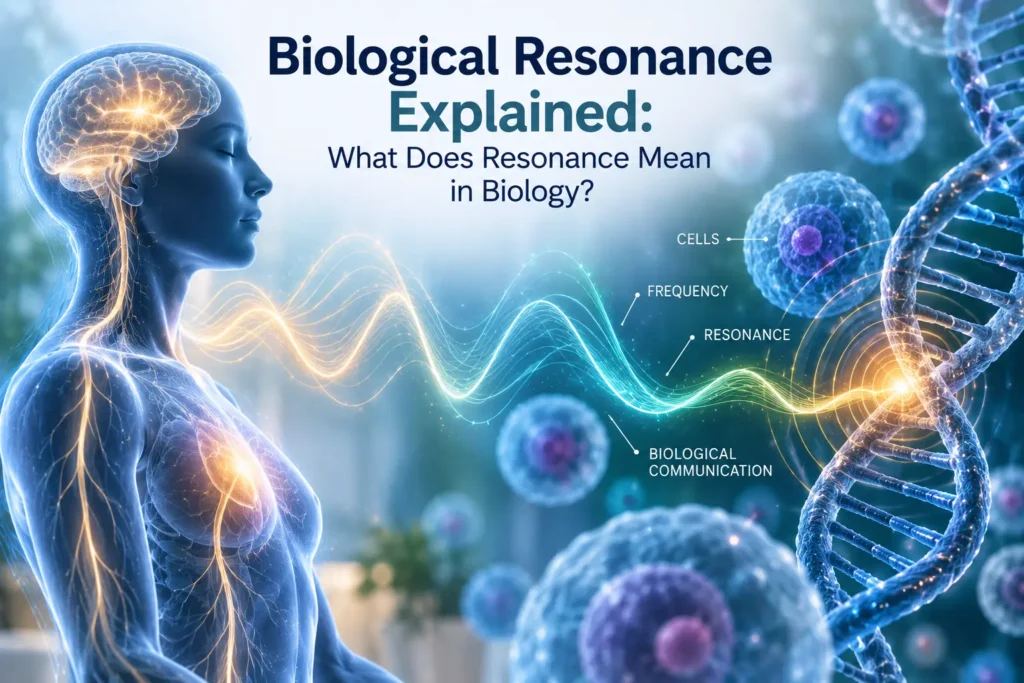
Biological resonance refers to the idea that living systems can respond to specific frequencies, rhythms, or signals. In biology, resonance can describe how cells, tissues, organs, or biological processes respond when an external or internal signal matches a system’s natural frequency or rhythm.
Key Takeaways
- Resonance is a response to specific frequencies or repeating signals.
- Biological systems naturally contain rhythms and oscillations.
- Resonance can be discussed at cellular, physiological, and biochemical levels.
- The concept is used in areas of biology, physics, and some complementary wellness approaches.
- Biological resonance should not automatically be considered a proven medical treatment.
What Is Biological Resonance?
Biological resonance is a concept used to describe frequency-dependent responses in living systems. The basic idea comes from resonance in physics, where an object can respond more strongly when exposed to a frequency that matches its natural frequency.
Living organisms are much more complex than simple physical objects. They contain cells, tissues, organs, electrical activity, chemical reactions, and biological rhythms that continuously interact.
Because of this complexity, the term “biological resonance” can have different meanings depending on the scientific or wellness context in which it is used.
How Does Resonance Work in Biology?
Biological systems are constantly producing and responding to signals. These may include electrical signals between nerve cells, chemical signals between cells, mechanical vibrations, and natural biological rhythms.
When a biological system responds to a particular frequency or rhythmic stimulus, researchers may investigate whether resonance-like behavior is involved.
For example, the human body has several naturally occurring rhythms, including heartbeat, breathing, brain activity, and sleep-wake cycles. These rhythms are regulated by complex biological mechanisms rather than by a single frequency.
Where Can Biological Resonance Be Observed?
The concept of resonance can be explored across different areas of biology.
1. Cellular Activity
Cells communicate through chemical and electrical signals. Some cellular processes also involve rhythmic or oscillating activity. Researchers study these patterns to understand how cells function and communicate.
2. Brain and Nervous System
Brain activity involves electrical patterns that change depending on sleep, attention, movement, and other states. These patterns are commonly studied using measurements such as electroencephalography (EEG).
3. Heart and Breathing
Heartbeat and breathing are examples of biological rhythms. They interact with the nervous system and can influence one another. Researchers study these relationships to better understand physiological regulation.
4. Biological Clocks
Circadian rhythms help regulate processes such as sleep, hormone production, body temperature, and metabolism. These internal rhythms respond to environmental signals, particularly light and darkness.
Is Biological Resonance the Same as Frequency?
Not exactly. Frequency describes how often a repeating event occurs over a specific period.
Resonance describes a stronger response that can occur when a system is exposed to a suitable frequency or pattern.
In biology, however, systems are highly interconnected and constantly changing. Therefore, biological responses cannot always be explained through simple resonance models.
Why Is Biological Resonance Important?
Studying biological rhythms and frequency-dependent responses can help researchers understand how living systems coordinate their activities.
Research into oscillations and biological signaling contributes to fields such as neuroscience, physiology, biophysics, and cellular biology.
The concept is also discussed in complementary wellness practices, including approaches that use the term “resonance” to describe interactions between the body and external frequencies.
However, claims about specific health benefits should be evaluated carefully. A scientific concept such as resonance does not by itself prove that a particular resonance-based therapy can diagnose, prevent, or treat a disease.
Biological Resonance and DNA Resonance Care
DNA Resonance Care uses the concept of resonance as part of its approach to wellness. The idea can be understood through the broader concept that biological systems involve complex patterns, signals, and interactions.
It is important to distinguish between the scientific study of biological frequencies and specific wellness claims. Evidence for a particular application should be considered separately rather than assuming that every use of the term “biological resonance” has the same scientific support.
Final Thoughts
Biological resonance is a broad concept connecting biology with the study of frequencies, rhythms, and responses in living systems. From cellular signaling to brain activity and circadian rhythms, biology contains many forms of organized oscillation.
Understanding the difference between established biological science and claims about particular resonance-based wellness methods is important when exploring this topic. DNA Resonance Care focuses on resonance as part of its wellness perspective while recognizing the importance of understanding the available scientific evidence.
Frequently Asked Questions
What does resonance mean in biology?
Resonance in biology generally refers to a stronger response of a biological system to particular frequencies, rhythms, or repeating signals. The exact meaning depends on the biological system and context.
Is biological resonance scientifically proven?
Resonance is a well-established physical phenomenon, and biological systems show many measurable rhythms and oscillations. However, evidence for specific resonance-based health applications varies and should be assessed individually.
Does the human body have natural frequencies?
The body contains many biological rhythms and oscillations, including heartbeat, breathing, brain activity, and circadian rhythms. These are generated and regulated by complex biological processes.
What is the relationship between DNA and resonance?
DNA is a complex biological molecule involved in storing genetic information. While biological systems can be studied in terms of molecular motion and physical signals, specific claims connecting DNA resonance to health require evidence from appropriate scientific research.
Can biological resonance be used for wellness?
Some complementary wellness approaches use the concept of resonance. Anyone considering such an approach should understand what is scientifically established and what remains under investigation.